

Read the previous sections of Modern Rituals Vol. I: The Dance Music Reformation:
The Introduction, Rave as Rapture, Rave as Resistance
Part I, Social Media and Social Tensions
Part II, Content Consciousness and the Degradation of Craft
Part III, Reframing “Commercial” vs “Underground”
Part IV, Materialists vs Moralists and the Foreclosure of Possibility
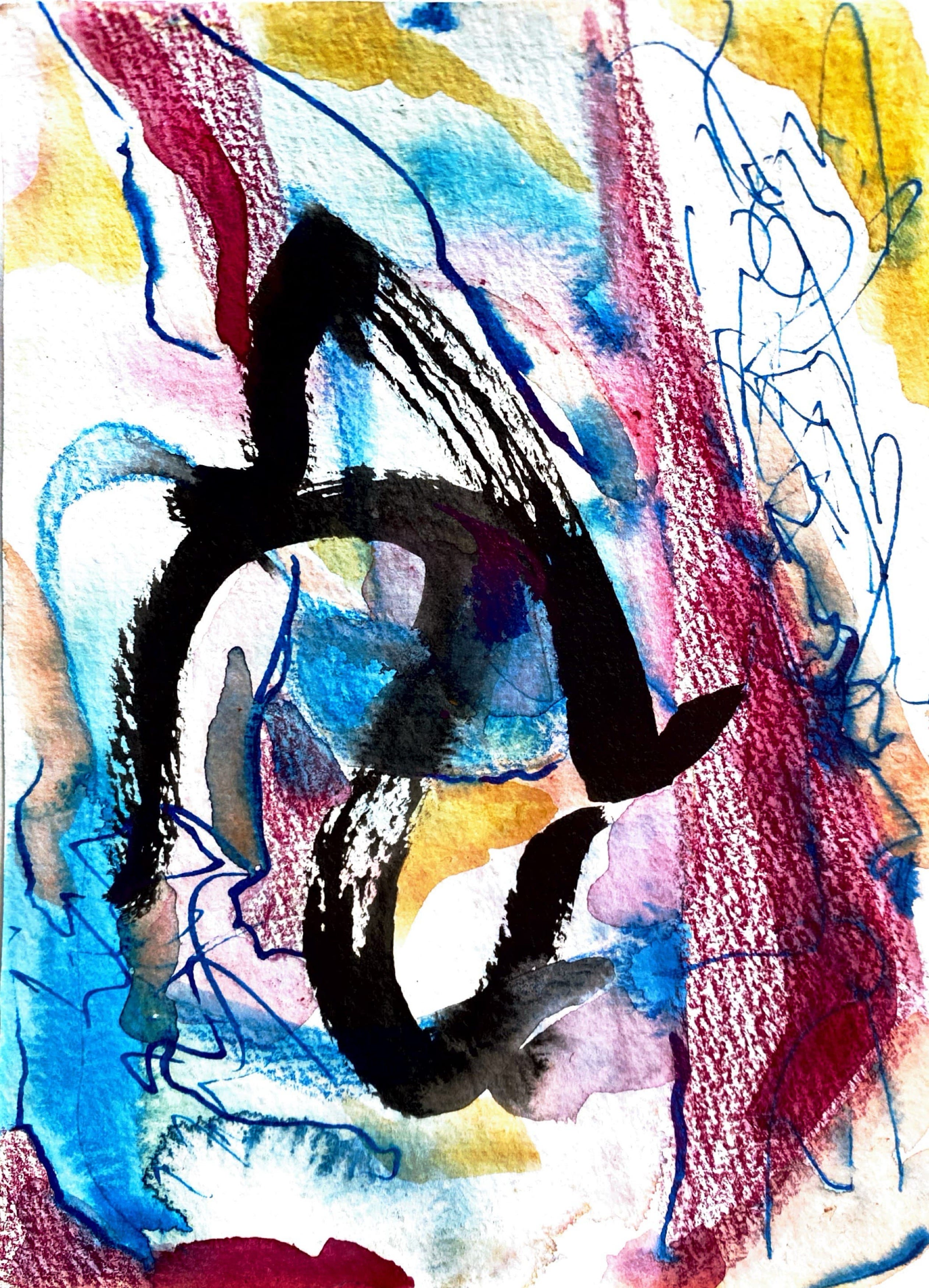
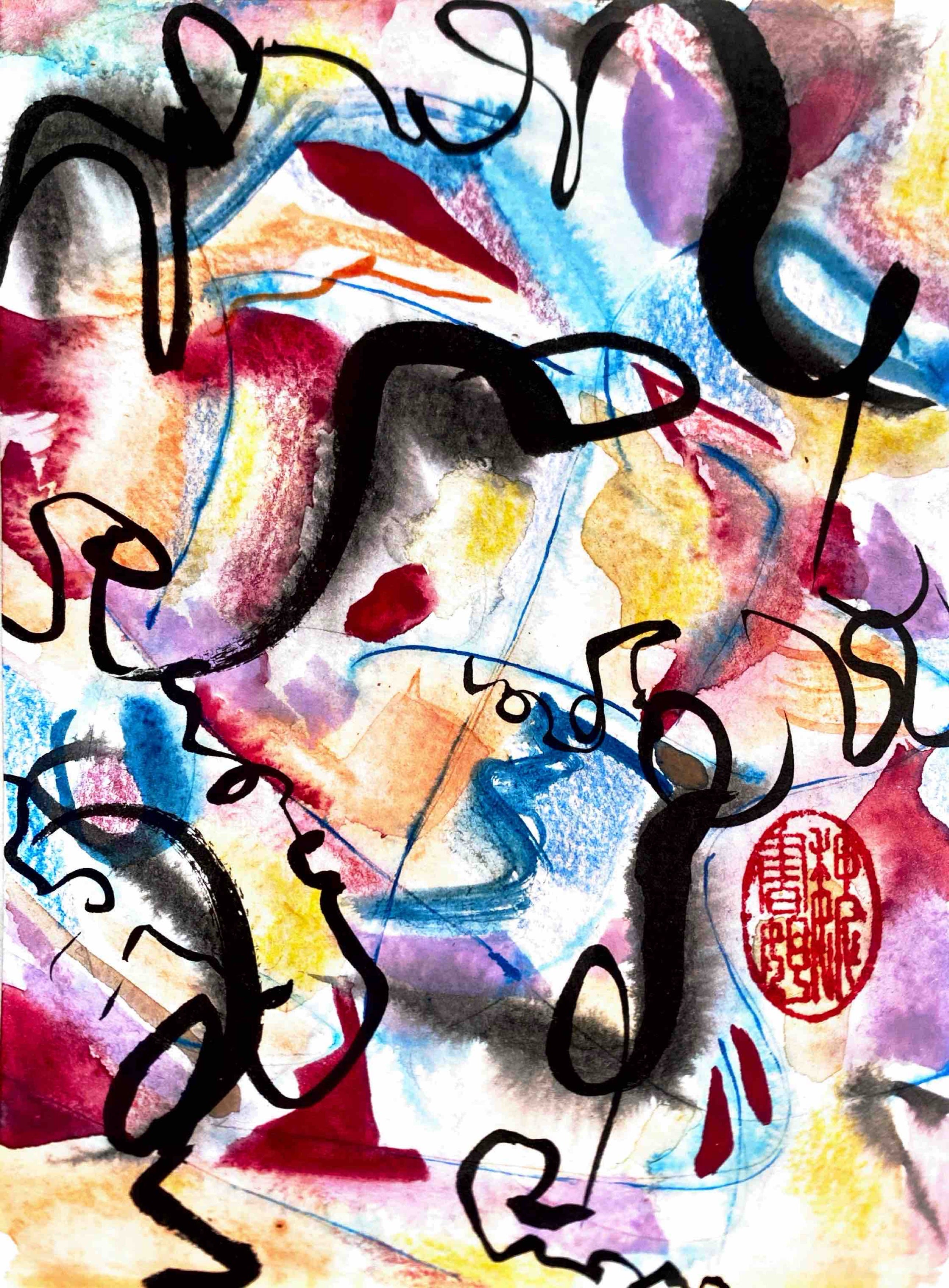
Each article is accompanied by original abstract paintings, also by Whitney Wei. All essays are available, read aloud, in audio format.
When I was younger, I renounced the existence of any God and decided that the world was a spiritually impoverished place. Transcendence was a foreclosed possibility in my life—as it is, I believe, currently in the lives of countless others. But it was this music culture that breached my cynicism and revived my sense of imagination through its catharsis.
A friend recently shared a quote with me from The Marriage of Heaven and Hell by English poet William Blake. He wrote, “If the doors of perception were cleansed, everything would appear to man as it is, infinite. For man has closed himself up, till he sees all things through narrow chinks of his cavern.” Another friend, on a phone call, told me that she believes hell isn’t some distant abstraction of the afterlife, but a state of consciousness that perpetuates its desolation and despair through ignorance.
Yet even these rigid mental conceptions of the world have the possibility to be engulfed by beauty. In his attempts to reconcile science with spirituality, the Dalai Lama reminded seekers “not to conflate the two processes of not finding something and finding its nonexistence.“
In experiencing electronic music, I was able to access a passage to another, inexpressible part of life that exalted flow and mystery, and while the art form itself does not have a distinctly spiritual component that can be empirically proven, this does not indicate its total lack thereof. It’s somewhere within this indeterminate space where true ecstasy lies. Electronic music is immaterial, impermanent, implicit and, in its purest forms, perhaps the closest thing to ritual that humans can observe in secular modernity.
To lose this completely would be a grave mistake. As a witness to these changes, veterans in this milieu know exactly what’s at risk here. Kangding Ray, the techno musician and upcoming Golden Globe ‘Best Original Score’ nominee, said, “I believe that this form of escapism within the framework of a club is one of the last genuine spaces for freedom we still have access to. If we don’t have this, we’re only left with endless social media scrolling and privatised commercial spaces. So, it’s an extremely precious thing that we have to protect at all costs.” He captured the stakes with an urgency in his message, saying, “In Berlin, people take clubbing so seriously, literally like their life depends on it. It’s not just about throwing a party or having fun anymore, it has become their essence of living. If that falls away, these folks will simply go insane.”
This psychic infrastructure that he speaks of is not an exaggeration, but an existential practice that carries enormous historical weight. Earlier in this essay, I briefly compared the rise of individualism through personal salvation within the European Reformation to the self-surveillance of post-pandemic dance music culture and the rise of the creator economy. Both resulted in an intractable age of anxiety.
Historian Lionel Trilling wrote, “In the late 16th and early 17th century, something like a mutation in human nature took place.” The popularity of self-portraiture and autobiographies by which to edit and present the self, the invention of mirrors, along with the possibility of upward mobility through outward “deception” and learned etiquette resulted in a psychological shift towards a new, guarded self.
This, plus the added burden on the Calvinist to save their own soul under the wrath of God, are what scholars cite as laying the groundwork for Protestant work ethic and subsequently, early capitalism. “Just as the soul struggled along its solitary path towards damnation or grace, the self toiled and schemed along a parallel trajectory in the material world,” wrote Barbara Ehrenreich in her book Dancing in the Streets.
This intolerable emotional isolation caused an epidemic of loneliness and melancholy. Many of these forsaken people turned towards work to escape their terror, but others simply went insane. “The flip side of the heroic autonomy that is said to represent one of the great achievements of the early modern and modern eras is profound isolation, and, with it, depression and sometimes death,” Ehrenreich wrote.
Certain parts of Europe experienced a surge in suicide once the region became a Calvinist stronghold. Protestants in the nineteenth century were twice as likely to take their own lives as Catholics. The parallels between the prevailing mood of the European Reformation and today should not be overlooked.
Platform capitalism punishes users with a similar pathological damnation. Last year, The Guardian reported that an increase in youth death rates, especially in North America, were “very tied up with the rise of anxiety and depression in young people, particularly women.” In another news article, the BBC reported that the US surgeon general issued a rare mental health advisory in December of 2021 on the rising number of youth suicide attempts, pointing to social media and the pandemic.
As demonstrated, acute and unceasing individualism has been the source of enormous psychic pain across centuries. In the absence of modern rituals, a society centred around technological progress and material comforts does nothing to alleviate this.
Collective joy, however, does. Raving, especially, is a temporary autonomous zone where transgression and indulgence can exalt the artist or the reveller, though it matters greatly which of Scheler’s apex of values—utility and hedonism or beauty and devotion—is used to attend to it. This is why parties are so variable in the dance music sphere, to correspond with the variable emotional registers that result from an event’s intention.
In her book, Ehrenreich wrote about what was lost in the transition between ancient Greek ecstatic rituals and secularised late medieval festivals—”something we might call meaning or transcendent insight.” The former endorsed the possibility of brushing against divinity at an intoxicating bacchanal whereas the Christian church in the latter case took that away, relegating drunken dancing into the domain of devilry. By splitting apart the coexistence of God and trance-like pleasure, the medieval Church degraded the carnival into debauched sites of “brawling and insensate drunkenness.” No longer a communion with God, these festivities fell to earth, a creation by and for mere mortals, and became viewed in the same superfluous frivolity as many contemporary parties are today.
But somewhere along the way, in the development of dance music culture, there were those who glimpsed the halcyon potential of moral uplift. These artists and curators and partygoers persisted in shaping this art form in such a sanctified image even when it was under continual threat by authoritarian forces. Through their work, this culture has now reached commercial acceptance, over-saturation even, but the resistance has evolved.
Unlike in the past, when dominant powers want to eradicate dancing completely, now they’ve found a way to preserve its shell for economic exploitation while siphoning away its essence. We exist in a world of capitalist realism, dominated by market and algorithmic logic, dictated by the whims of the technological machine. Such atomising, almost totalitarian, ideologies can so easily permeate our microcosm’s collective consciousness and reshape our culture in its own image. Its tyranny imposes upon us the belief that our values and history are anachronistic and better left behind, when they are, in fact, the bedrock and bulwark of everything we have and everything we must remember.
What is being lost is not imperceptible, either. To add, there is a difference between the expansion beyond oneself versus the complete obliteration of oneself, and I fear we’re skewing towards the latter. On recent nights out, I’ve seen it in the deadness and vacuity in people’s eyes as they wander around like brittle shells, barely holding onto their extinguished spirits. That emptiness and vicious hunger results from a society that has extracted so much from the individual themselves that this hollowness and predation then turns outwards, towards one another. It’s evident, yes, through hedonism’s thin veil of self annihilation, but also in the nuances of an interaction: from thieves in the club, to bodies obstructing others in a space, in the way people aren’t truly present with or look right through you, or when a communal gathering assumes an inchoate charge of psychological danger.
The solution, then, must be ontological, at the very level of being itself. This Counter Reformation emerges through firm intent—through cooperation, meditative practice, alternative broadcast structures, holding institutions to moral account, and interpersonal acts of kindness. Our consciousness is porous and mutable enough to recover, though it is no easy feat. We relentlessly combat fragmentation and distraction, the very mechanisms that sever us from reality and one another, with radical presence and attention—as if our culture depended on it, which it absolutely does.
With signs of fascism on the rise around the world, perhaps dance floors carry a greater weight than we can even begin to imagine. In her book The Origins of Totalitarianism, German philosopher Hannah Arendt wrote, “It has been observed that terror can rule absolutely only over men who are isolated against each other and that, therefore, one of the primary concerns of all tyrannical government is to bring this isolation about. Isolation may be the beginning of terror; it certainly is its most fertile ground.” Arendt’s work concerned itself with the dire question, “How can we protect spaces of freedom?”
Through rapture and resistance, we must return electronic music to the sacred context within which it rightfully belongs and protect it as a modern ritual capable of connection and healing. Perhaps it is only through the conditions of afflicting emptiness, pushed to the furthest brink, that a fervent spiritual hunger will arise. With this, we extol the dissolution of a neurotic, solipsistic ego. Buddhist philosophy considers the continual grasping of the illusory, permanent self as the ultimate form of suffering. Ecstasy, in ancient Greek, means “to stand outside oneself.” In fiercely defending our means to do so, and defending the dance floor as the final frontier, only then can we truly remain free.
MODERN RITUALS VOL. I - COMPLETE WORKS CITED
“About Us.” Boiler Room, boilerroom.tv/about. Accessed 3 Dec. 2025.
Almeida, Rachel Grace. “The Great Regression.” Resident Advisor, 25 Sept. 2025, ra.co/features/4469.
Benjamin, Walter. The Work of Art in the Age of Mechanical Reproduction. Penguin Books, 2008.
The Bible. King James Version, Mark 8:36.
Bickers, Eleanor. “Breach the Peace.” Minimal Collective, 1 May 2024, www.minimalcollective.digital/editorial/breach-the-peace.
Blake, William. The Marriage of Heaven and Hell. Oxford University Press, 1975.
Confucius. Analects: With Selections from Traditional Commentaries. Translated by Edward Slingerland, Hackett Publishing Company, 2003.
Correal, Annie. “After 91 Years, New York Will Let Its People Boogie.” The New York Times, 30 Oct. 2017, www.nytimes.com/2017/10/30/nyregion/new-york-cabaret-law-repeal.html.
Durkheim, Émile. The Elementary Forms of Religious Life. Oxford University Press, 2005.
Ehrenreich, Barbara. Dancing in the Streets: A History of Collective Joy. Holt Paperbacks, 2007.
Emmerzael, Hugo. “Existential Rave: Kangding Ray on Scoring ‘Sirāt.’” Filmmaker Magazine, 16 Oct. 2025, filmmakermagazine.com/132234-interview-composer-kangding-ray-sirat.
Fisher, Mark. “Baroque Sunbursts.” Rave: Rave and its Influence on Art and Culture, edited by Nav Haq, Black Dog Publishing, 2016.
Gillespie, Sybil. “The Art of DJing: Eris Drew.” Resident Advisor, 22 Nov. 2018, ra.co/features/3352.
Gonsher, Aaron. “Last Night a DJ Saved My Soul.” Red Bull Music Academy Daily, Aug. 2015, daily.redbullmusicacademy.com/2015/08/house-techno-religion-feature.
Hancox, Dan. “Wiley: Godfather of Grime.” The Guardian, 24 Jan. 2017, www.theguardian.com/music/2017/jan/24/wiley-godfather-grime.
Harper, Leah. “Squaring Up: How Insta-Fashion Is Changing the Way We Shop.” The Guardian, 31 Mar. 2019, www.theguardian.com/fashion/2019/mar/31/squaring-up-how-instagram-fashion-is-changing-the-way-we-shop.
Hylton, Ria. “30 Years of the CDJ: The Technology That Revolutionised DJ Culture.” DJ Mag, 25 Sept. 2024, djmag.com/features/30-years-of-cdj-technology-revolutionised-dj-culture.
“Jane Fitz on Raving in 90s Hong Kong and the Mystery of the Underground.” Music Not Diving with Scuba, uploaded by Scuba, 25 Mar. 2025, www.youtube.com/watch?v=UK8fv4xzykM.
Jennings, Phin. “Dance Music Divided: Cultural Boycotts and Boiler Room’s Israel Controversy.” The Guardian, 14 Oct. 2025, www.theguardian.com/music/2025/oct/14/dance-music-divided-cultural-boycotts-boiler-room-israel.
Jung, C. G. The Undiscovered Self: The Dilemma of the Individual in Modern Society. Penguin Publishing Group, 2006.
Lawson, Michael. “Boiler Room to Undergo Substantial Layoffs.” Resident Advisor, 24 Nov. 2025, ra.co/news/84063.
Lay, Kat. “High Youth Death Rates from Drugs, Alcohol and Suicide an ‘Emerging Crisis.’” The Guardian, 12 Oct. 2025, www.theguardian.com/global-development/2025/oct/12/global-burden-disease-study-high-youth-death-rates-drugs-alcohol-suicide-emerging-crisis.
Lindberg, Carter. The European Reformations. 3rd ed., Wiley-Blackwell, 2021.
McGilchrist, Iain. “A Revolution in Thought?” Darwin College Lecture Series, uploaded by Darwin College Lecture Series, 9 Feb. 2024, www.youtube.com/watch?v=AuQ4Hi7YdgU.
Postman, Neil. Amusing Ourselves to Death: Public Discourse in the Age of Show Business. Viking Penguin, 1986.
Postman, Neil. Technopoly: The Surrender of Culture to Technology. Knopf Doubleday Publishing Group, 1993.
Reynaldo, Shawn. “No One Is Going to Defend Boiler Room.” First Floor, 25 Nov. 2025, firstfloor.substack.com/p/no-one-is-going-to-defend-boiler.
Siltanen, Joe. “MDLBeast Festival Is ‘Culture-Washing’ Saudi Arabia’s Authoritarian Regime.” Resident Advisor, 8 Dec. 2021, ra.co/features/3948.
Thompson, Evan. Waking, Dreaming, Being. Columbia University Press, 2014.
Vernon, Will. “Suicide Is on the Rise for Young Americans, with No Clear Answers.” BBC News, 12 Apr. 2024, www.bbc.com/news/world-us-canada-68782177.
Wei, Whitney. “Open Ground: The Nightclub in a Second World War Bunker.” The Guardian, 21 July 2025, www.theguardian.com/music/2025/jul/21/open-ground-wuppertal-germany-nightclub-second-world-war-bunker.
the writing, watercolours and recording - we don't deserve you!!! loved this entire series <3